If you don't live in Korea currently, you're probably completely unaware that the Korean presidential election is happening this year. Those of us in the Land of the Morning Calm have been COMPLETELY UNABLE TO IGNORE THIS. Ok, maybe those in the Cities are more aware than those in the countryside, but still... we've been surrounded by this for months now...
 |
| On every fence... |
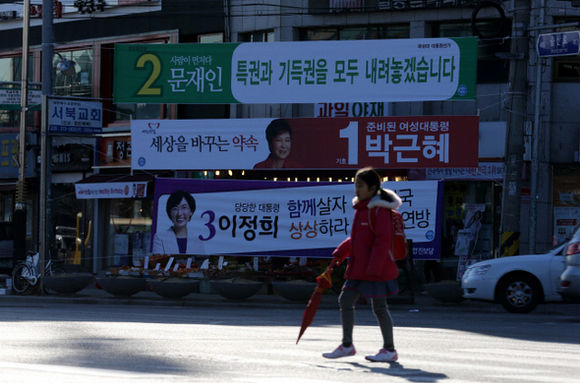 |
| On every street corner... |
 |
| These people who are so excited to see you as you come out of the subway or off the bus... |
 |
| These people who emerge from these weird pop-up bandstands |
 |
| And whatever the hell this is... |
The following is a crash course on Korean the Korean political system:
South Korea is a Democrazy... sorry, Democracy
It actually resembles the American system pretty well. It's a democratic republic, which means there's a legislative body of representatives similar to the American senate, and an executive branch (though the lines between the two are more blurred than in America).
 |
| ... true, but stick with me, you might learn something. |
The legislative branch is called the National Assembly. It's pretty much like Congress and the senate combined. Of the 300 members, 244 are single-seat constituency representative, and 56 are proportional representation (so if the area you live in has a large population, but is not considered a constituency, you'll have more representatives... at least I think that's how it works...). National Assembly elections are held every four years, the next one is scheduled for 2016. The presidential elections are held every five years and a president is only permitted to be elected once.
Unlike the States, Korea is not technically a two-party system; there are four parties with any sort of weight behind them, but about 8 more running in the background, and then the normal insane number of "no way in hell" parties. There really are only two parties that are typically elected. These are the Saenuri Party (Conservative) and Democratic United Party (Liberal, shocking!).
 |
| OTHER COUNTRIES ARE KINDA LIKE OUR COUNTRY! |
In the current presidential race there is (or was, depending on when you read this) Park GeunHye (Saenuri) and Moon JaeIn (DUP) as the frontrunners. Even though they are from two different parties the difference between the two is, from an outsider's perspective, is negligible. The only real significant difference is opposing views on North Korea. Saenuri has an impressive "NO, NO WAY, FUCK THOSE GUYS!" stance while DUP is more "but... they're starving... and we have extra food... come on, man!" stance.
 |
| Maybe they'll share some of their unicorn science with us! |
The 2012 Election
I was very surprised that, when talking to Koreans in the weeks leading up to the election, many people aren't really positive which candidate they support. The parties are so similar that it appears polarization is less of an issue here than in Korea. However, most people were really disappointed that the third primary candidate, Ahn CheolSuu, dropped out of the race. Though it is widely accepted that Ahn and Moon would have split the liberal vote and handed Park a victory, people seemed much more excited and confident about Ahn than about Moon. The other shocking thing about this election is that Park GeunHye is a candidate at all, let alone a front-runner. It's not just the fact that she's a woman, but the fact that she is the daughter of former dictator Park ChungHee (considered by some to be the father of Korea's impressive meteoric rise to economic power and by others to be a symbol of governmental oppression). The mud-slinging moniker of "the Dictator's Daughter" has done a lot to hurt Park, and then this didn't help.
After a very interesting and intense race South Korea has elected its first female president. This race was insanely close, with a record number of Korean youths turning up to the polls. The Saenuri president Lee MyungBak (currently seated president) was wildly unpopular by both the DUP and his own party, so it's kind of impressive that the party managed to remain untarnished and get their candidate elected. The major issues swaying undecided voters was Park's policy on North Korea and Moon's promise to raise taxes in order to support new welfare programs (something both candidates promised to do, Moon just had a plan to pay for them).
So there you have it, a quick crash course on current Korean politics. I'm hoping to write another crash course about the history of Korean politics, but that one will require a BIT more research.
